-ET Word Family: Word List and Teaching Activities
What you’ll learn:
- What the -ET word family is and how it fits into early short E learning
- A sample list of -ET words sorted from simple to more challenging
- Fun, practical activities to help your child read and spell -ET words at home
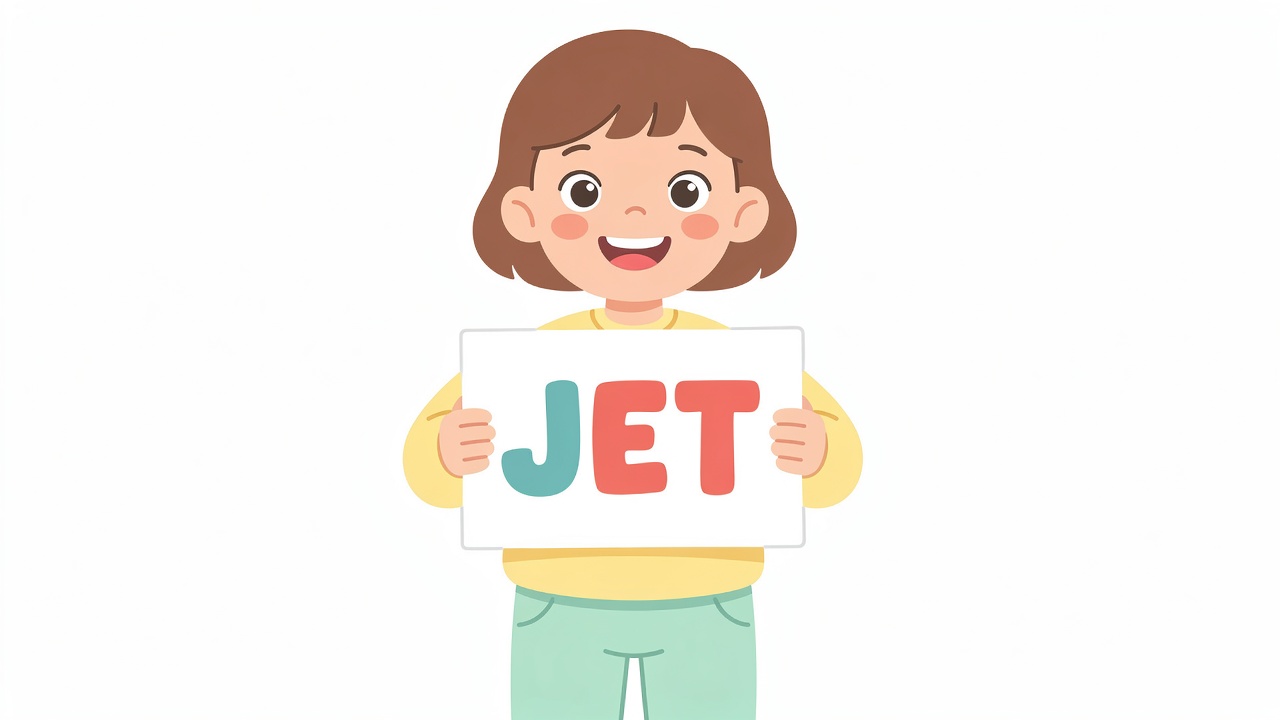
The -ET word family rounds out the short E cluster beautifully. If your child has already worked through -ED and -EN, the short E sound is already familiar — now it’s just a matter of swapping the ending consonant. Words like jet, net, pet, and wet are vivid, easy to picture, and great fun to work with. By the time your child has all three short E families under their belt, they’ll be reading a huge range of words with real fluency.
What Is the -ET Word Family?
A word family is a group of words that share the same vowel-consonant ending. The -ET family includes all words ending in -ET, like jet, net, fret, and sweat.
In phonics, that shared ending is the rime and the starting letter or letters are the onset. In pet, p is the onset and -et is the rime. Teaching children to read the rime as one chunk rather than blending three separate sounds is what builds reading speed and fluency over time.
-ET uses the same short E sound as -ED and -EN — the /e/ you hear in egg and elephant. If your child knows those families already, they’re already halfway here. If -ET is their first short E family, it’s worth spending a few minutes contrasting short E with short A before jumping in — the two vowel sounds can get mixed up easily at this stage.
-ET Word Family Word List
Here’s a sample list of -ET words, grouped from simplest to a little more challenging:
Simple 3-Letter -ET Words
| Word | Use in a sentence |
|---|---|
| jet | The jet flew across the sky. |
| net | She caught the fish in a net. |
| pet | He has a pet rabbit. |
| set | She set the cups on the shelf. |
| wet | His boots got wet in the rain. |
| bet | I bet it will rain today. |
| met | She met her friend at the gate. |
| get | Go and get your coat. |
4-Letter and Longer -ET Words
| Word | Notes |
|---|---|
| fret | Begins with a consonant blend (fr-) |
| whet | Uses wh- digraph; to sharpen something |
| reset | Two syllables; re- prefix; good for more advanced readers |
| Tibet | Proper noun; great for geography vocabulary |
Tip: Jet, net, pet, and wet are the four to focus on first — they’re concrete, visually rich, and show up regularly in early readers. Get is worth introducing early too since it’s one of the most common words in everyday English.
-ET Words in Simple Sentences
Reading -ET words in full sentences is what bridges the gap between pattern practice and real reading fluency. Try these decodable sentences with your child:
- The jet flew fast over the big hill.
- She used a net to catch the red fish.
- His pet rabbit got wet in the rain.
- He met his dad at the set of steps.
- Go and get your hat before you fret.
- The wet dog shook itself and ran to its pet bed.
Sentence 3 packs three short E words together — a great challenge for children who are ready to pick up speed.
How to Teach -ET Word Family Words at Home
Here are four easy, effective activities that work well at home:
1. Onset Swap Warm-Up
Say /et/ out loud together, then take turns adding onset sounds: j-et, n-et, p-et, s-et, w-et. Keep it moving fast once your child knows the pattern — the speed itself builds automaticity, which is what makes fluent reading possible. A quick two-minute swap game before reading practice makes a noticeable difference.
2. Short E Family Showdown
Gather cards from all three short E families: -ED, -EN, and -ET. Shuffle them together and have your child sort into three piles. This is the most powerful consolidation activity for short E — it forces children to discriminate between bed, ben, and bet, which look almost identical but sound subtly different. Kids who can sort these reliably are well on their way to confident short E reading.
3. Pet Shop Story Game
Tell your child they’re opening a pet shop, and every pet’s name has to end in -ET. What’s your jet-black cat called? What about the wet otter? This imaginative game gets children generating -ET words in context, which is far more engaging than drilling a list — and it works on vocabulary and creativity alongside phonics.
4. Connect -ET to Short A Families
Mix -ET words with -AT words: jet / cat, net / bat, pet / hat. Ask your child to sort them by vowel sound — short E or short A. This cross-vowel sort is excellent for children who are starting to move beyond individual families and into broader vowel discrimination, which is a key skill for independent reading.
Free -ET Word Family Worksheet
Download our free -ET word family worksheet (PDF) — it includes tracing, fill-in-the-blank, and a circle-the-word activity for kindergarten and grade 1. Print and go.
Frequently Asked Questions
What are some -ET word family words for kindergarten?
Great starter -ET words for kindergarteners include jet, net, pet, set, and wet. These simple three-letter CVC words are easy to decode once a child knows the short E sound and can recognize the -ET pattern at the end of a word.
How do you teach the -ET word family to beginners?
Start by saying the -ET ending out loud together: /et/. Then swap the first sound: j-et, n-et, p-et, s-et. Always begin orally before moving to writing or flashcards. Hearing the pattern clearly first is what makes reading and spelling -ET words click for young children.
What is the difference between word families and phonics?
Phonics is the full system of letter-sound relationships. Word families are a teaching shortcut within phonics — they group words by a shared ending like -ET so children can recognize and decode whole chunks quickly rather than sounding out every individual letter.
Keep Exploring
- Letter Sounds — full phonics hub
- -ED Word Family: Word List and Teaching Activities
- -EN Word Family: Word List and Teaching Activities
- -AT Word Family: Word List and Teaching Activities
- -AP Word Family: Word List and Teaching Activities
- Free -ET Word Family Worksheet (PDF)
Do You Even Need to Teach Word Families?
The -ET ending is two sounds: /e/ and /t/. That’s it. A child who knows those two individual sounds can already decode jet, net, pet, and every other -ET word without ever being shown the pattern as a group. Word families are a useful shortcut — but the real power lies in the individual sounds underneath them.
When a child has truly solid, automatic knowledge of each letter sound, word families don’t need to be memorized — they just emerge naturally as children read. And that same foundational skill works on every word they’ll ever encounter, not just the ones in a list.
That’s the approach behind the Children Learning Reading program. Instead of building up through word family after word family, CLR teaches each individual phonemic sound explicitly and systematically from day one. It’s simple, it’s proven, and parents have used it to teach children as young as 2 and 3 to read fluently.
Find out more about the Children Learning Reading program here — it might change how you think about teaching your child to read.
-ET is the third short E family — if you haven’t already, work through -ED and -EN alongside it. Practicing all three together gives your child a solid grip on the short E sound that will carry through into more advanced reading patterns.
Want a Complete Reading Program?
Our step-by-step program teaches children to read fluently using proven phonics methods.
Learn More →