Letters and Sounds – Leaning Letter K and the /k/ Sound
Letter K and /k/ Sound Activities

The letter K is another "unvoiced" sound of the alphabet where no vibration is made in the vocal cords. Other letters such as F, H, and S are also unvoiced sounds. Here, the letter K makes the exact same sound as letter C, and this voiceless sound is really made by pushing a short puff of air through your mouth.
Try saying the /k/ sound several times.
See video below:
Letter K is also a short sound, meaning that you cannot stretch it, by trying to say it as "KUH". If you sounded it as /kuh/ it becomes a voiced sound where the ending "-UH" sound is made by the vocal cords, and this is incorrect. While you may see the /k/ sound written sometimes as "kuh" or "cuh", do NOT sound it as such. No sound should be coming from your vocal cords.
If you compare the /k/ and /g/ sounds, you’ll notice that both sounds are made with the same mouth shape and position. The unvoiced /k/ sound is simply a quick puff of air being pushed out of your mouth, whereas the /g/ sound IS voiced and sound is made by your vocal cords. Here are some example words:
KID – /k/ /i/ /d/
KEG – /k/ /e/ /g/
KEEP – /k/ /ee/ /p/
Learning Activity for /k/
- Make a printout for the letter K and the following words:
- KID
- KIT
- KING
- KITTEN
- BACK
- PACK
- Show the letter K and explain how to make its sound.
- Have your child repeat the /k/ sound several times.
- Practice the /k/ sound with the above listed words. You can add your own words as well to this list.
- With the words provided, ask your child to show you where the /k/ sound is in the word.
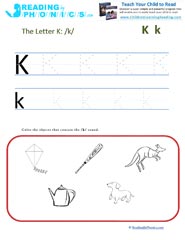
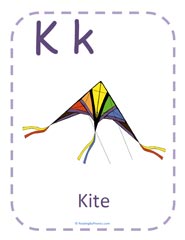
- Work with the worksheet provided for letter K and its sound below.
Letter K Worksheets
>> Click here to teach your child to read today with a super simple, effective program.

Related Reading
Want a Complete Reading Program?
Our step-by-step program teaches children to read fluently using proven phonics methods.
Learn More →